
The three key business pillars are;
- Having a product that solves a problem
- Knowing who needs your solution
- Differentiating yourself from competitors
All these 3 things revolve around one key focus area; Knowing your market segment.
In this guide, we’ll show the ways to understand the differences in your customer base and how you can build your customer segmentation strategy.
What is B2B Market Segmentation?
B2B market segmentation is about finding groups of potential customers who are similar. Maybe it is companies based in a specific area or companies focusing on one niche industry? Perhaps it’s key decision makers sharing the same job title? When businesses know what these groups have in common, they can communicate with them better. This helps in using resources wisely, talking to customers in a way they understand, offering solutions they need, and selling things more effectively.
If you don’t split up your customers into these groups, you’re basically treating them all the same. It’s like trying to talk to a bunch of different nationalities using the same language.
And if you don’t bother with segmentation, your marketing probably won’t work well for anyone.
So let’s dive deeper into this.
The Marketing Segmentation Funnel
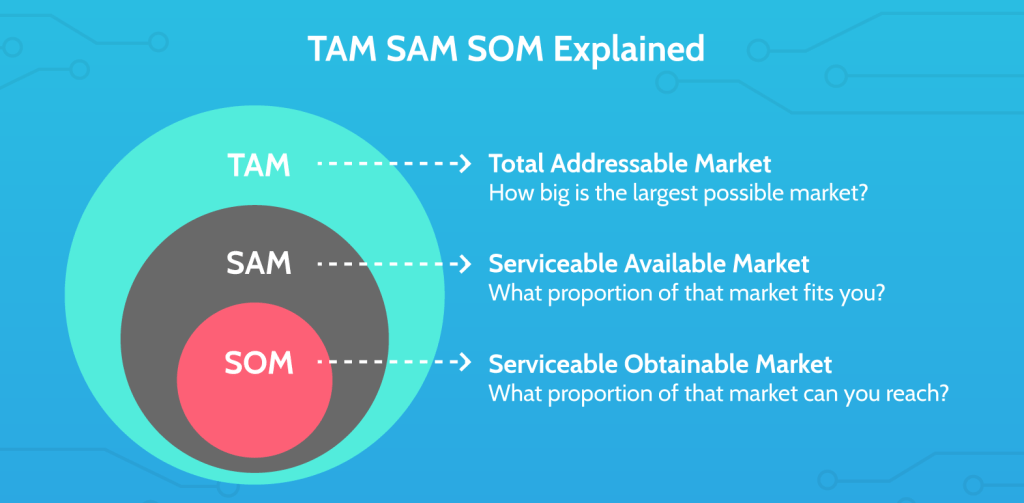
The easiest way to understand how to nail down to your key market segment is by looking at the Total Addressable Market (TAM), Serviceable Addressable Market (SAM) and Serviceable Obtainable Market (SOM).
Total addressable market (TAM)
Right at the top, you have your total addressable market. This is the grand sum of all potential customers. It is the total revenue opportunity for a product or service if 100% market share is achieved. It’s the broadest view of the market and doesn’t consider any segments.
Serviceable available market (SAM)
This segment narrows your TAM to the business you serve, such as industry, demographics or geography.
Serviceable Obtainable market (SOM)
This is where you narrow your focus and that’s where your marketing strategy starts to take place. What proportion of the addressable market are you able to obtain? This is where further segmenting can take place. Perhaps you target tech companies in the US, but it’s only start-ups or SMEs you’re after, or maybe it’s only larger corporations with 500+ employees in terms of company size? These are quite different segments, whilst one may have CEO or Co-Founder as the decision maker, the latter may have 5-7 C-level decision makers. So the more you narrow down your segment, the better chances you’ll have of reaching your ideal decision maker.
There are many other ways to segment your ideal target market, like segmentation by buyer stage. Where are those prospective customers in your sales funnel? Are they engaged accounts that may benefit from more of your educated content? Are they opportunities that require more social proof, where case studies and reviews would help you win the client? Perhaps they’re an existing customer who can benefit from your ongoing support and available materials to get the maximum benefits of being your customer?
Find and segment your ideal customers with Ezee Prospects
With our fully managed service, we use live data to find your ideal target market, suited to your specific offer. Email is still the most preferred way of contact for business buyers and it works much better than a cold phone call. Save wasted prospecting hours by using a method that works!
Subscribe now for top B2B marketing tips to your inbox
 B2B Lead Generation Done For You
Leave a comment